
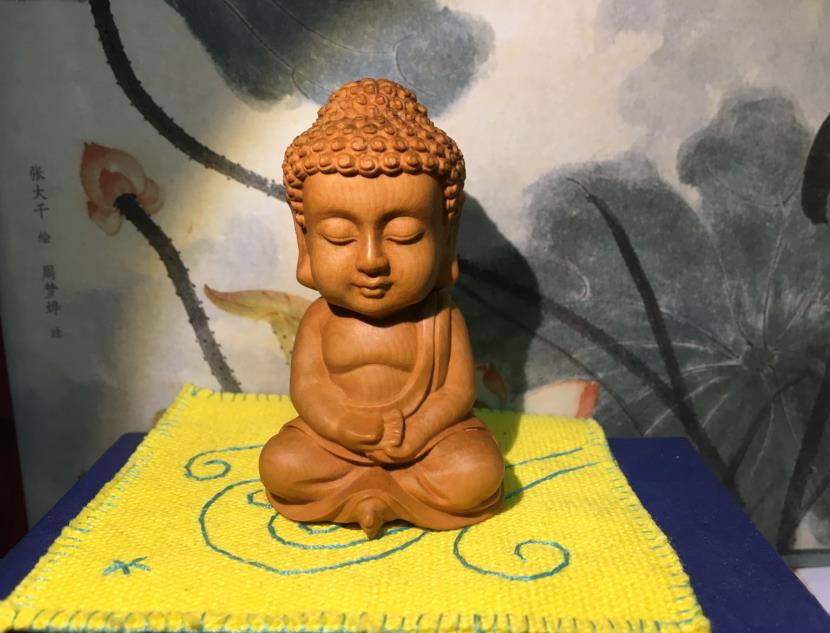
To establish Buddhism, it must address three significant theoretical questions that people are genuinely interested in.
Question One: Is there samsara?
A crucial question that needs to be addressed in Buddhism is whether people actually become ghosts or other forms of existence after death. This question is particularly significant because many individuals do not have a clear understanding of it, which leads to disbelief and a lack of reverence for Buddha Dharma. For such individuals, samsara is merely a tale without any real impact on their lives. However, if they were to witness transmigration realms of hell and hungry ghost in samsara, it could potentially frighten them to the point of death.
Understanding the transmigration realms of hell and hungry ghosts in samsara presents a challenge, as these realms cannot be perceived through normal human senses. Our physical senses are limited, with our eyesight inferior to eagles, our sense of smell inferior to dogs, and our hearing inferior to dolphins. While our mental consciousness is powerful and has the ability to reason, it is an inferential process that cannot directly perceive these realms. Through reasoning, we can acknowledge the existence of the six transmigration realms, including hell, heaven, and hungry ghosts. However, we cannot directly see these realms like we can see human beings and animals. As a result, many people find it difficult to truly believe in the concept of samsara.
Some individuals may imagine scenarios in order to satisfy their curious minds, such as the existence of a soul that leaves the body after death and travels elsewhere for reincarnation. However, this belief is incorrect. Buddhism does not recognize the existence of a soul, as it fixates on the concept of permanence. This fixation arises because individuals mistakenly assume that the world is exactly as they perceive it to be. According to this belief, an immortal soul will exit the body after death and find another embryo to inhabit for another life, but this is a misconception.
There are numerous Buddhist theories that attempt to explain the concept of samsara, such as Madhyamaka and Cittamatra. However, due to time constraints, I will provide a brief explanation of these theories later. Fully understanding the complexity of samsara can take more than a few days of exploration and clarification. Personally, I have dedicated several decades to critically examine Madhyamaka and Cittamatra and have not identified any flaws in these theories. On the other hand, I have come across various flaws in scientific theories.
Question Two: Is There the Law of Causality?
Buddhism asserts that virtuous deeds will yield positive outcomes, while evil deeds will result in negative consequences. However, can this principle be substantiated? This notion holds significant weight in our decision to accept or reject Buddhist teachings. The law of causality is not as straightforward as we may assume; simply performing a few kowtows before a Buddha statue or burning incense at a temple on New Year's Day does not guarantee blessings or wealth. Many individuals who carry out these practices do not experience the expected outcomes. Therefore, it is essential not to underestimate the intricacies of the law of cause and effect. Its comprehension involves several theories that require thorough exploration.
Question Three: Is There Liberation?
The Three Seals of Buddhism are the fundamental principles that summarize the Buddha's teachings. They are: all composite phenomena are impermanent, all phenomena are devoid of self, and nirvana is peaceful. The first two seals emphasize the impermanent and empty nature of all phenomena, while the third seal describes the ultimate goal of Buddhist practice, which is to attain a state of perfect peace and liberation called nirvana. Nirvana is not merely eternal happiness, but a state beyond all suffering and dualistic perceptions. It is the ultimate realization of the true nature of reality, which is beyond all concepts and limitations.
The three seals can be explained with great clarity in theory, and they can also be realized through practice. Buddhism is the only philosophy that offers a path to realization of these seals. In contrast, materialism, subjective idealism, and objective idealism are incomplete in their theoretical frameworks and unachievable in practice. As such, they cannot offer a means to attain the ultimate truth and freedom that the Buddhist path promises.
It is my belief that no one has truly seen God. Even if one were to see a luminous figure speaking accurately about unknown matters, it does not necessarily confirm that what they are seeing is the omniscient God. It may more likely be a lesser deity. The notion that God is all-knowing implies that one would need to be equally all-knowing in order to claim to have seen Him. However, if one were to assert that they are omniscient, then they themselves would be God. This creates a theoretical conflict that is difficult to reconcile.
Buddhism is the only philosophy that posits that every sentient being possesses the Buddha nature and has the potential to attain omniscience, just like the Buddha. This statement is internally consistent within the framework of Buddhist philosophy. To understand why this is the case, it is necessary to delve into the fundamental tenets of Buddhism.
Excerpted from: Buddhist Worldview and Modern Life



Comments (0)